We plan training to the minute and food to the gram, then leave sleep to chance. Yet sleep is when the training load turns into adaptation: tissue is repaired, motor skills are consolidated and the nervous system resets. This article reviews what the research says about sleep, performance, injuries and muscle, then turns it into a practical evening routine.
Why sleep is part of the training plan
Training does not make you stronger by itself; it stresses the body, and adaptation happens during the recovery that follows. Sleep is the longest and deepest part of that recovery. Treating it as a break from the programme throws away part of what you paid for in the gym.
A 2021 expert consensus in the British Journal of Sports Medicine concluded that athletes are particularly exposed to short and poor-quality sleep — late training and competition, travel, pre-competition anxiety — and recommended that sleep be routinely assessed and improved as part of athlete care.[4]
What happens to performance when you sleep more?
In a well-known Stanford study, 11 college basketball players were asked to spend 10 hours in bed every night for 5 to 7 weeks after a normal baseline period. Their actual sleep rose from about 6.75 to about 8.5 hours, and nearly everything that was measured improved:[1]
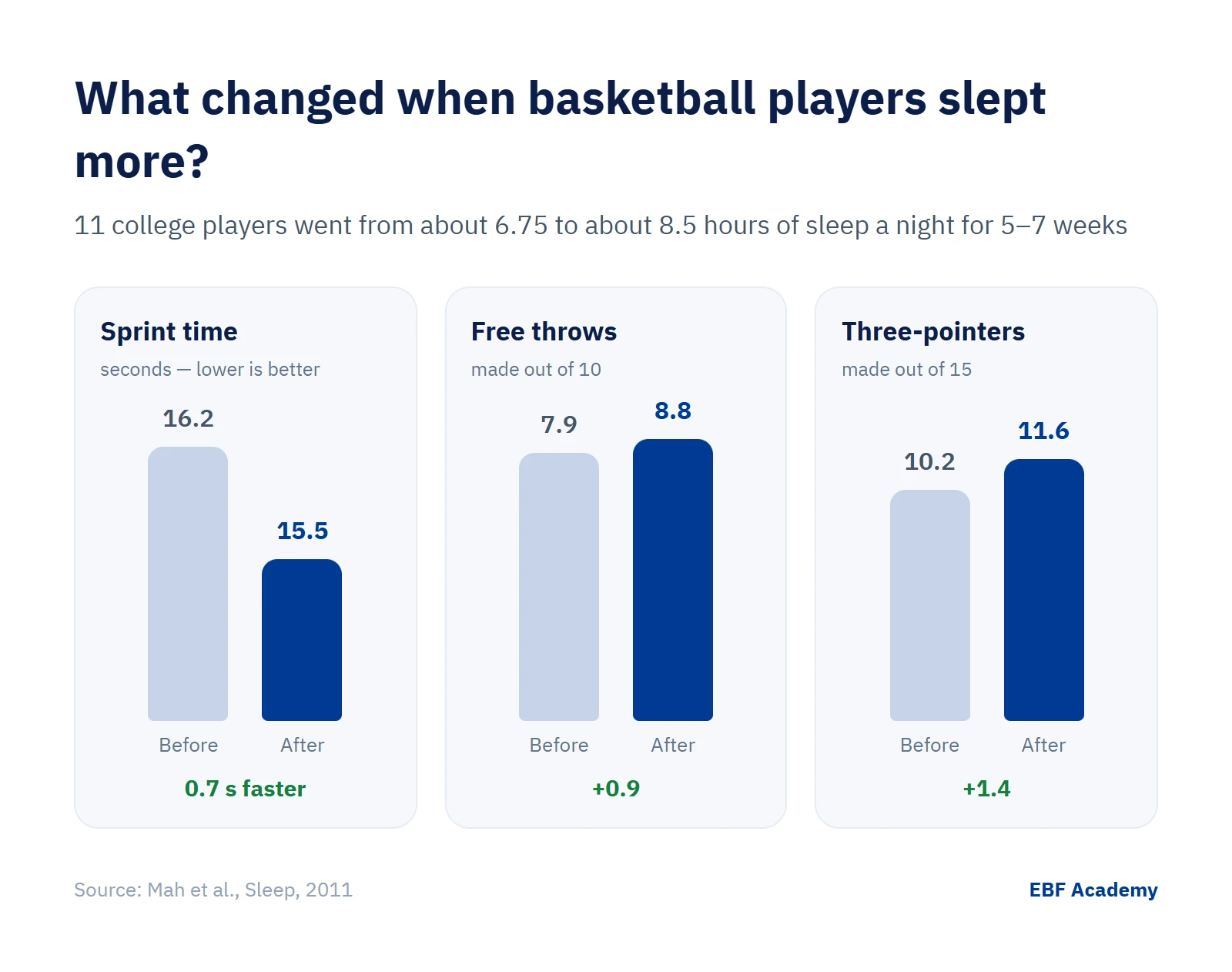
Sprint time fell from 16.2 to 15.5 seconds, free throws rose from 7.9 to 8.8 out of 10, and three-pointers from 10.2 to 11.6 out of 15. Players also reported feeling better physically and mentally during practice and games.
Limits of the evidence
The sample was small (11 players) and there was no control group, so some of the improvement may reflect ongoing in-season training or the players’ own expectations. Still, the direction of the results fits what sleep-deprivation studies show, which is what makes it worth taking seriously.
One night without sleep slows muscle building
If your goal is muscle, sleep is not a detail. In a 2021 randomised crossover trial, 13 healthy young adults spent one night with no sleep and, on another occasion, a normal night, and muscle protein synthesis was measured after each.[2]
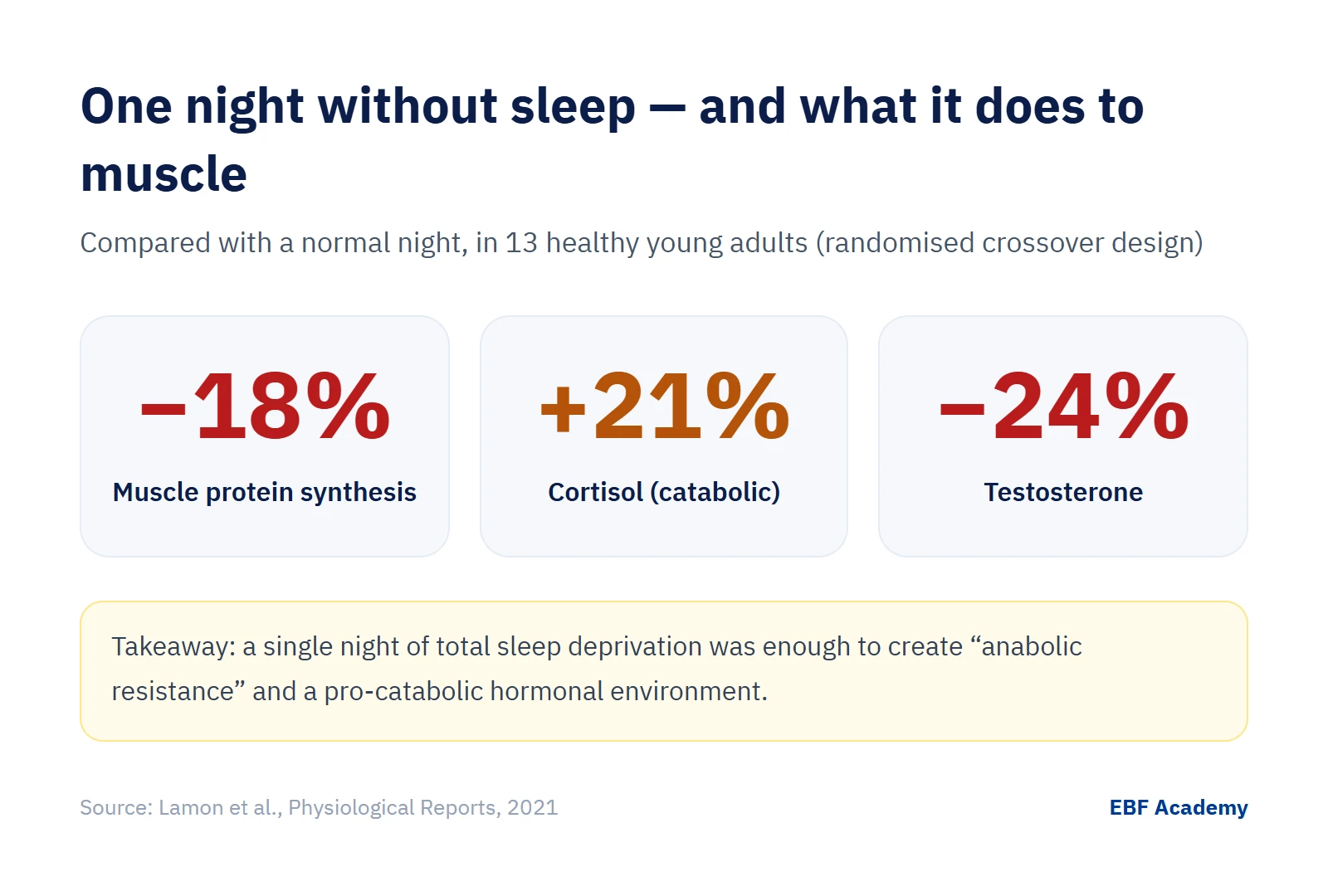
Muscle protein synthesis fell by 18%, cortisol rose by 21% and testosterone fell by 24%. The researchers concluded that a single night is enough to create “anabolic resistance” and a pro-catabolic hormonal environment. The good news is that the reverse also holds: protecting your sleep is one of the simplest ways to protect your gains.
Short sleep and injuries
In a group of 112 adolescent athletes, those who slept less than 8 hours a night on average were about 1.7 times more likely to be injured than those who slept 8 hours or more, and hours of sleep was one of the strongest factors linked to injury in the study.[3]
This is an observational study: it shows an association, not proven cause and effect — an overloaded, stressed athlete may both sleep less and get hurt more. But the likely mechanisms make sense: fatigue slows reaction time and blunts motor control and attention, exactly what protects joints in critical moments.
How much do you actually need?
The US National Sleep Foundation recommends 7 to 9 hours for adults aged 18 to 64, and 8 to 10 hours for teenagers.[5] For athletes under heavy training loads, the expert consensus suggests needs may be higher, and that they vary between individuals.[4]
A simple practical check: if you need an alarm every day, feel sleepy in the middle of the day and sleep far longer on days off, you are probably not sleeping enough.
What about naps?
Naps are a useful way to make up part of a shortfall, especially on double-session days or after travel. Keep them short (around 20 to 30 minutes) and early in the afternoon so they do not eat into night-time sleep. A nap is a top-up, not a substitute for enough sleep at night.
A practical, evidence-based evening routine
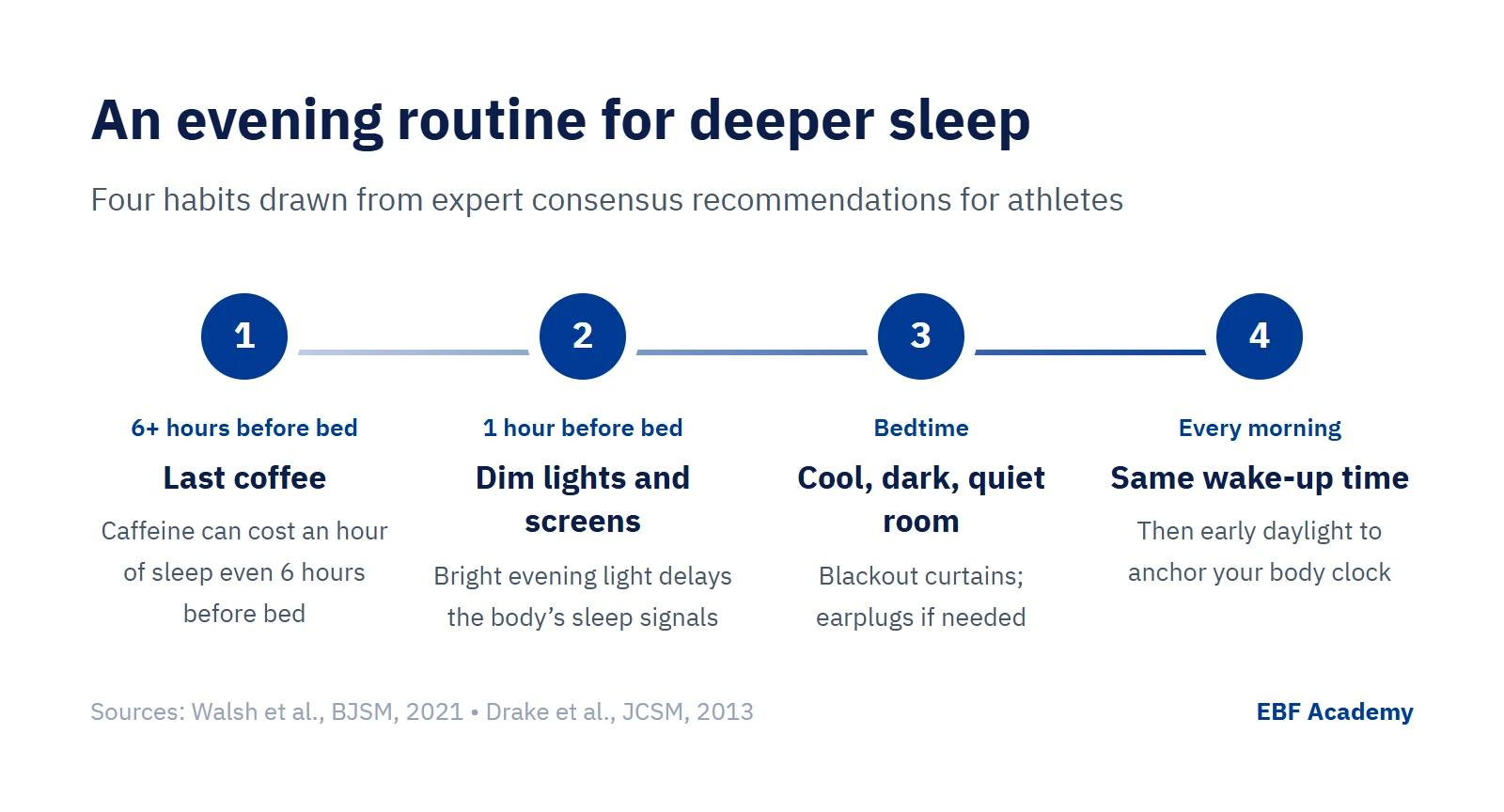
- Caffeine: keep your last dose at least six hours before bed. In a controlled trial, 400 mg of caffeine cut sleep by more than an hour even when taken six hours before bedtime.[6] Energy drinks and many pre-workouts carry large amounts.
- Light: dim the lights in the last hour before bed and keep screens away where you can; bright evening light delays the body’s natural sleep signals.
- The room: cool, dark and quiet. Blackout curtains and earplugs are a cheap investment with a big return.
- Regularity: keep the same wake-up time, even on days off, and get daylight early in the morning; that is what anchors your body clock and brings sleepiness on time.
Practical tip
If you train in the evening, build a wind-down after it: a warm shower, dim lighting and a recovery meal that is not too late. Log your bed and wake times for two weeks before changing anything — what is not measured does not improve.
Key takeaways
- Sleep is when training becomes adaptation — treat it as part of the programme.
- Sleep extension was linked to faster sprints and better accuracy in athletes.
- One night without sleep cut muscle protein synthesis by about 18%.
- Sleeping under 8 hours was linked to higher injury risk in adolescent athletes.
- Early caffeine cut-off, dim evenings, a cool dark room and a fixed wake-up time.
References
- Mah CD, Mah KE, Kezirian EJ, Dement WC. The effects of sleep extension on the athletic performance of collegiate basketball players. Sleep. 2011;34(7):943–950. doi.org/10.5665/SLEEP.1132
- Lamon S, Morabito A, Arentson-Lantz E, et al. The effect of acute sleep deprivation on skeletal muscle protein synthesis and the hormonal environment. Physiol Rep. 2021;9(1):e14660. doi.org/10.14814/phy2.14660
- Milewski MD, Skaggs DL, Bishop GA, et al. Chronic lack of sleep is associated with increased sports injuries in adolescent athletes. J Pediatr Orthop. 2014;34(2):129–133. doi.org/10.1097/BPO.0000000000000151
- Walsh NP, Halson SL, Sargent C, et al. Sleep and the athlete: narrative review and 2021 expert consensus recommendations. Br J Sports Med. 2021;55(7):356–368. doi.org/10.1136/bjsports-2020-102025
- Hirshkowitz M, Whiton K, Albert SM, et al. National Sleep Foundation's sleep time duration recommendations. Sleep Health. 2015;1(1):40–43. doi.org/10.1016/j.sleh.2014.12.010
- Drake C, Roehrs T, Shambroom J, Roth T. Caffeine effects on sleep taken 0, 3, or 6 hours before going to bed. J Clin Sleep Med. 2013;9(11):1195–1200. doi.org/10.5664/jcsm.3170
Written by
EBF Academy
Writes for EBF Academy, the evidence-based fitness education platform for coaches and athletes.