

Somewhere between “your body can’t use more than 30 grams of protein at a time” and “eat 3 grams per kilogram”, lifters get lost in contradictory numbers. The good news is that this research has matured enough to give clear, practical answers on how much, how to spread it and when to eat it.
The daily amount: where does 1.6 come from?
In the largest meta-analysis on the topic, researchers pooled 49 studies with 1,863 people doing resistance training. More protein led to greater gains in muscle mass and strength, but the extra benefit for fat-free mass levelled off at around 1.6 grams per kilogram of body weight per day.[1]
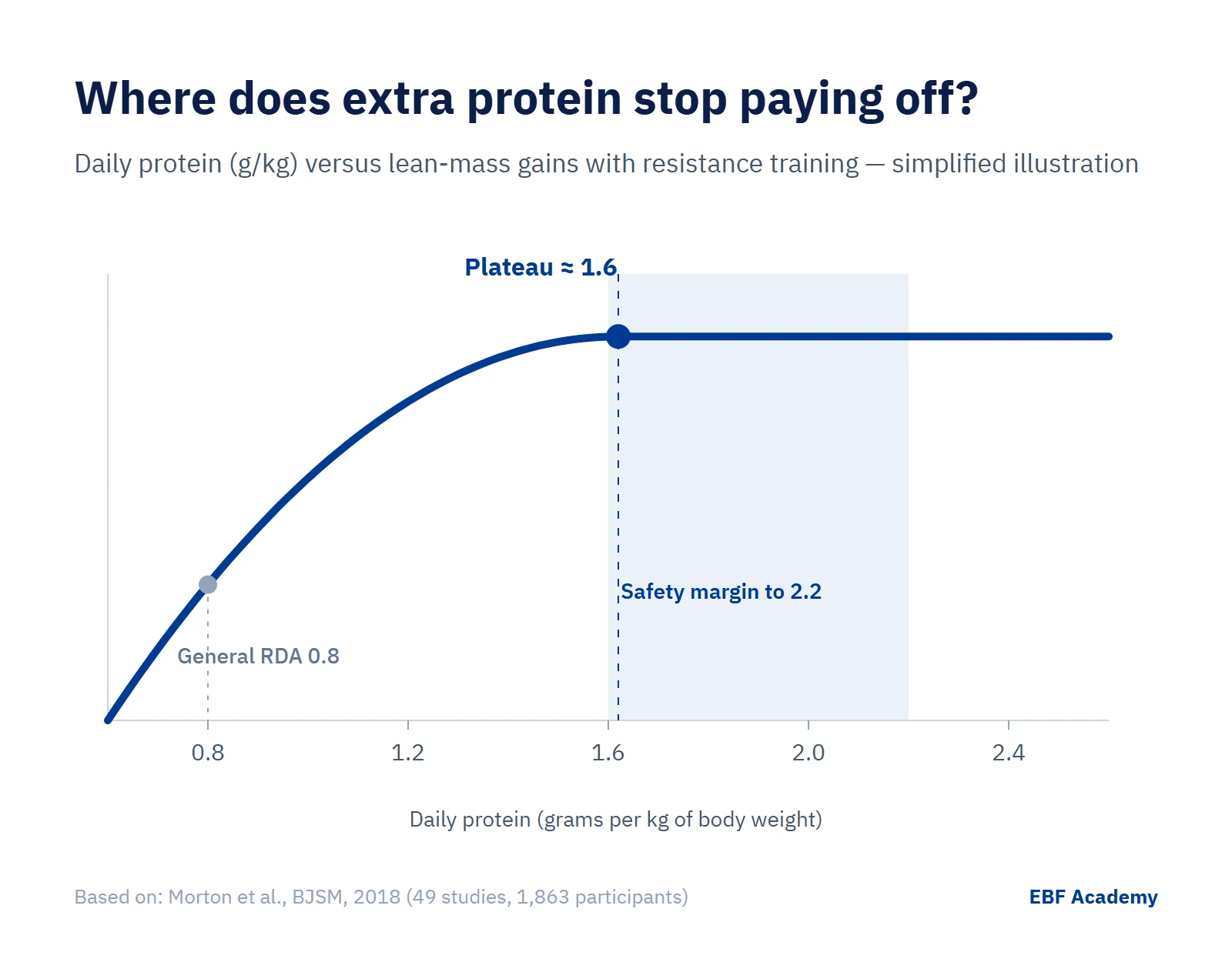
That figure is an average, not a hard limit, and people differ. Many researchers therefore suggest that going up to about 2.2 g/kg covers that variation for anyone who wants to maximise results. This is consistent with the International Society of Sports Nutrition, which recommends 1.4 to 2.0 g/kg per day for most exercising individuals.[2]
Practical tip
If you carry a lot of excess weight, base the calculation on your target weight rather than your current weight, or the number will be inflated.
Quick reference by body weight
Body weight | Daily protein (1.6–2.2 g/kg) | Per meal, 4 meals (0.4–0.55 g/kg) |
|---|---|---|
60 kg | 96–132 g | 24–33 g |
70 kg | 112–154 g | 28–39 g |
80 kg | 128–176 g | 32–44 g |
90 kg | 144–198 g | 36–50 g |
100 kg | 160–220 g | 40–55 g |
Figures are rounded. The lower end suits most people; the upper end is for heavy training or a cutting phase where you want to protect muscle.
Is there a limit per meal?
For years the claim went that the body “can’t absorb” more than 20–30 grams per meal and the rest is wasted. That isn’t accurate: the body absorbs nearly all of it; the real question is how much is used to build muscle.
In a 2023 study, trained participants took either 25 or 100 grams of milk protein after resistance exercise. The 100-gram dose produced a larger anabolic response that lasted more than 12 hours — the body does not simply “throw away” the extra, as was once believed.[4]
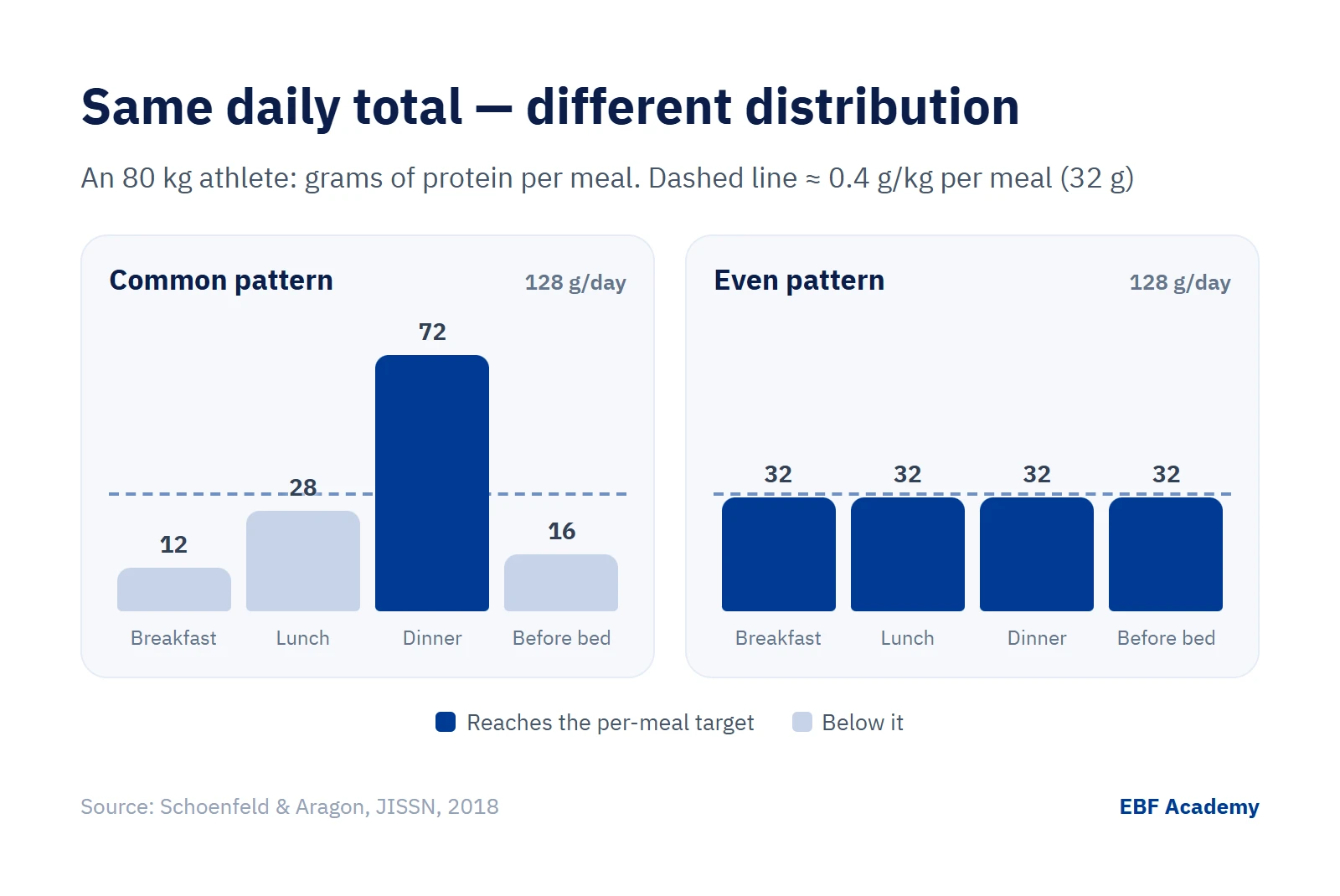
Spreading protein across meals is still a smart choice: Schoenfeld and Aragon suggest about 0.4 g/kg per meal across at least four meals to reach 1.6 g/kg a day, rising to 0.55 g/kg per meal for those aiming at 2.2.[3]
Timing: is the 30-minute window real?
The idea that you must eat protein within 30 minutes of training or lose the opportunity is overstated. When researchers analysed the protein-timing studies, the effect of timing all but disappeared once daily intake was matched between groups.[5] Your daily total matters far more than the minute you eat.
That doesn’t make timing worthless: if you train fasted or many hours after your last meal, a protein feed close to training makes sense. But the “window” is much wider than the marketing suggests.
Protein before bed
In a 12-week trial, a group taking about 27.5 grams of casein before sleep gained more muscle size and strength than a placebo group.[6] The protein group also ate more protein overall, so part of the benefit may come from the amount rather than the timing. The practical message: a pre-bed protein feed is an easy way to add a fourth meal.
Where to get it
You don’t need supplements to hit your target; they are simply convenient. Approximate values for common sources:
Food | Portion | Protein (g) |
|---|---|---|
Chicken breast, cooked | 100 g | ≈ 31 |
Lean beef, cooked | 100 g | ≈ 26 |
Canned tuna, drained | 100 g | ≈ 25 |
Whey protein | 30 g scoop | ≈ 22–25 |
Greek yoghurt | 200 g | ≈ 18–20 |
Lentils, cooked | 1 cup (≈ 200 g) | ≈ 18 |
Eggs | 3 large | ≈ 18 |
Cottage cheese | 100 g | ≈ 11–13 |
Milk | 250 ml | ≈ 8 |
Values vary by product and cooking method. Animal and dairy proteins are rich in leucine; plant-based eaters can compensate with a slightly higher intake and a mix of legumes and grains.
What about the kidneys?
In healthy people, studies have not shown kidney harm at these intakes. Anyone with kidney disease or a chronic condition should set their intake with their doctor.
Key takeaways
Aim for 1.6 g/kg a day, up to 2.2 g/kg if you want a safety margin.
The body uses more than 30 g per meal, but four meals is still a smart split.
Daily total matters more than exact timing around training.
A pre-bed protein meal is an easy way to complete your intake.
Food is enough; supplements are only a convenience.
References
Morton RW, Murphy KT, McKellar SR, et al. A systematic review, meta-analysis and meta-regression of the effect of protein supplementation on resistance training-induced gains in muscle mass and strength in healthy adults. Br J Sports Med. 2018;52(6):376–384. doi.org/10.1136/bjsports-2017-097608
Jäger R, Kerksick CM, Campbell BI, et al. International Society of Sports Nutrition position stand: protein and exercise. J Int Soc Sports Nutr. 2017;14:20. doi.org/10.1186/s12970-017-0177-8
Schoenfeld BJ, Aragon AA. How much protein can the body use in a single meal for muscle-building? Implications for daily protein distribution. J Int Soc Sports Nutr. 2018;15:10. doi.org/10.1186/s12970-018-0215-1
Trommelen J, van Lieshout GAA, Nyakayiru J, et al. The anabolic response to protein ingestion during recovery from exercise has no upper limit in magnitude and duration in vivo in humans. Cell Rep Med. 2023;4(12):101324. doi.org/10.1016/j.xcrm.2023.101324
Schoenfeld BJ, Aragon AA, Krieger JW. The effect of protein timing on muscle strength and hypertrophy: a meta-analysis. J Int Soc Sports Nutr. 2013;10:53. doi.org/10.1186/1550-2783-10-53
Snijders T, Res PT, Smeets JSJ, et al. Protein ingestion before sleep increases muscle mass and strength gains during prolonged resistance-type exercise training in healthy young men. J Nutr. 2015;145(6):1178–1184. doi.org/10.3945/jn.114.208371
Written by
EBF Academy
Writes for EBF Academy, the evidence-based fitness education platform for coaches and athletes.